

Today a harness is the everyday choice for walking a dog. For most of history it was not. For thousands of years people held on to their dogs by the neck, with a collar and a leash, and the harness was working equipment: something you put on a dog that pulled a sled, a cart or a load. This is the story of how it went from one to the other.
Antiquity: the collar comes first
The oldest leashes and collars appear in the art of Egypt and Mesopotamia. Egyptian tomb paintings show hunting dogs on leads, and two decorated leather collars were found in the tomb of Maiherpri, a noble buried in the Valley of the Kings in the 15th century BC.

In the palace reliefs of Nineveh, large mastiff-type dogs strain on thick leashes held by their handlers on the way to the royal hunt. In Greece and Rome working dogs wore wide collars, and shepherd dogs sometimes wore spiked ones: the Roman writer Varro describes a collar studded with nails, meant to protect the dog's neck from wolves. The aim was protection and control, and all of it happened at the neck.
The first harnesses: dogs that pull
The harness was born where dogs had to pull. In the Arctic, people have used dogs to haul sleds for around 9,000 years: remains of sleds and of dogs bred for the work have been found on Zhokhov Island, in the Siberian Arctic. On the North American plains, dogs dragged the travois, a frame of two poles, long before horses arrived.
A dog pulls with its chest and shoulders, not with its throat. The harnesses these peoples made from hide and sinew spread the load across the chest, so a dog could work for hours without choking. That basic principle has not changed since.

The Middle Ages: hounds on the leash
In medieval Europe dogs were above all a matter of the hunt. The best-known hunting book of the period, the Livre de la chasse, written by Gaston Phoebus, Count of Foix, in 1387–1389, explains in detail how to feed, train and care for hounds, and how a scent hound was worked on a long leash to track the game.

The collars in these images are wide and brightly coloured, and noble houses had them decorated with metal and their coat of arms. The harness still had no place in everyday life with a dog.
Draught dogs: the harness goes to work in town
For centuries, and into the early 20th century, dogs pulled carts across much of Europe. In Belgium, the Netherlands, northern France and Germany, dog carts delivered milk, bread and vegetables and carried the wares of pedlars and knife-grinders. The dogs were cheap to keep and strong for their size.
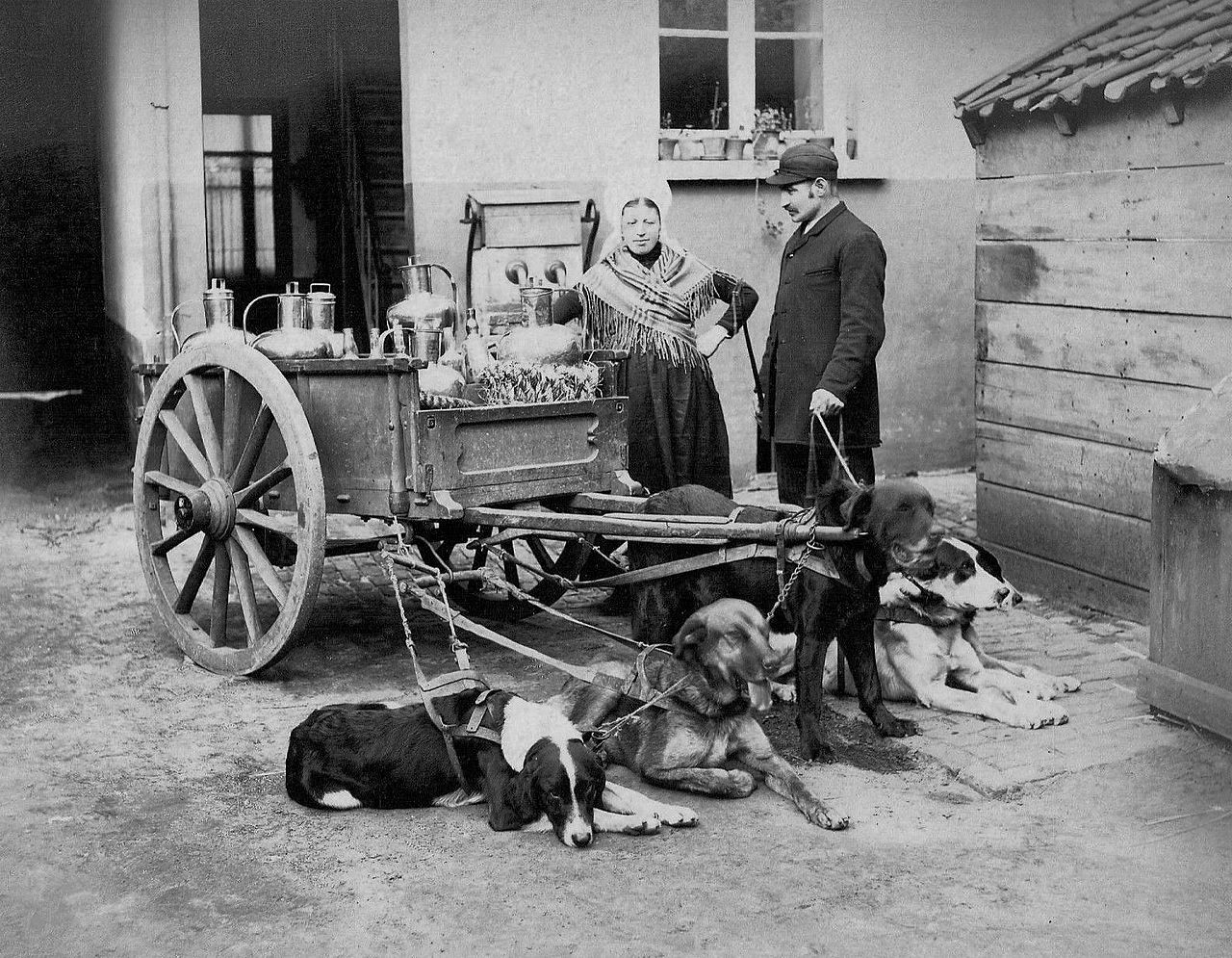
Working conditions were often harsh. Britain banned dog carts in London in 1839 and across England in 1854, while in Belgium and the Netherlands they remained a common sight well into the 20th century. In August 1914 the Belgian army even used dogs to pull its machine guns.
Sled dogs, gold and the serum run
At the end of the 19th century the Klondike gold rush (1896–1899) made sled dogs precious: prospectors in Alaska and the Yukon needed teams to carry supplies and mail. Freight teams wore strong, simple harnesses with a padded collar or chest strap and traces running back along the dog's sides to the sled.
In the winter of 1925, relays of sled dog teams carried diphtheria antitoxin more than 1,000 km across Alaska to the town of Nome. Balto, lead dog of the final team, became famous around the world, and the sled dog became a symbol of endurance.
The world wars: harnesses for service
In the First World War armies used tens of thousands of dogs. Messenger dogs ran between the lines, and Red Cross dogs searched the battlefield for wounded soldiers. They wore light harnesses or saddle-cloths carrying a red cross, first-aid supplies or message tubes: an early form of the vest harnesses that working dogs wear today.

The guide dog harness
The same war left many soldiers blind. In 1916 the first guide dog school opened in Oldenburg, Germany, to train dogs for them. A guide dog's harness is not for pulling but for communication: a rigid U-shaped handle lets the person feel every change of direction and every stop.
In 1927 the American Dorothy Harrison Eustis wrote about the German schools, and a young blind man, Morris Frank, asked her for a dog. He came back from Switzerland with Buddy, and in 1929 they founded The Seeing Eye, the first guide dog school in the United States.

The modern harness: from work to the everyday walk
After the Second World War, nylon webbing and plastic buckles made harnesses light, cheap and easy to wash, and they began to move from working dogs to family dogs. With them came a better understanding of the dog's body: vets and trainers pointed out that a dog pulling on a collar puts pressure on its throat and neck, while a harness spreads the force across the chest.
Today harnesses come in many forms: the Y-harness, which leaves the shoulders free to move; front-clip harnesses that help with pulling; X-back and sport harnesses for canicross, bikejoring and skijoring; and vest harnesses for working dogs. The materials keep changing too, from leather and cotton to nylon, and from nylon to coated webbing that does not absorb water, mud or smells.
Where BAILU fits in
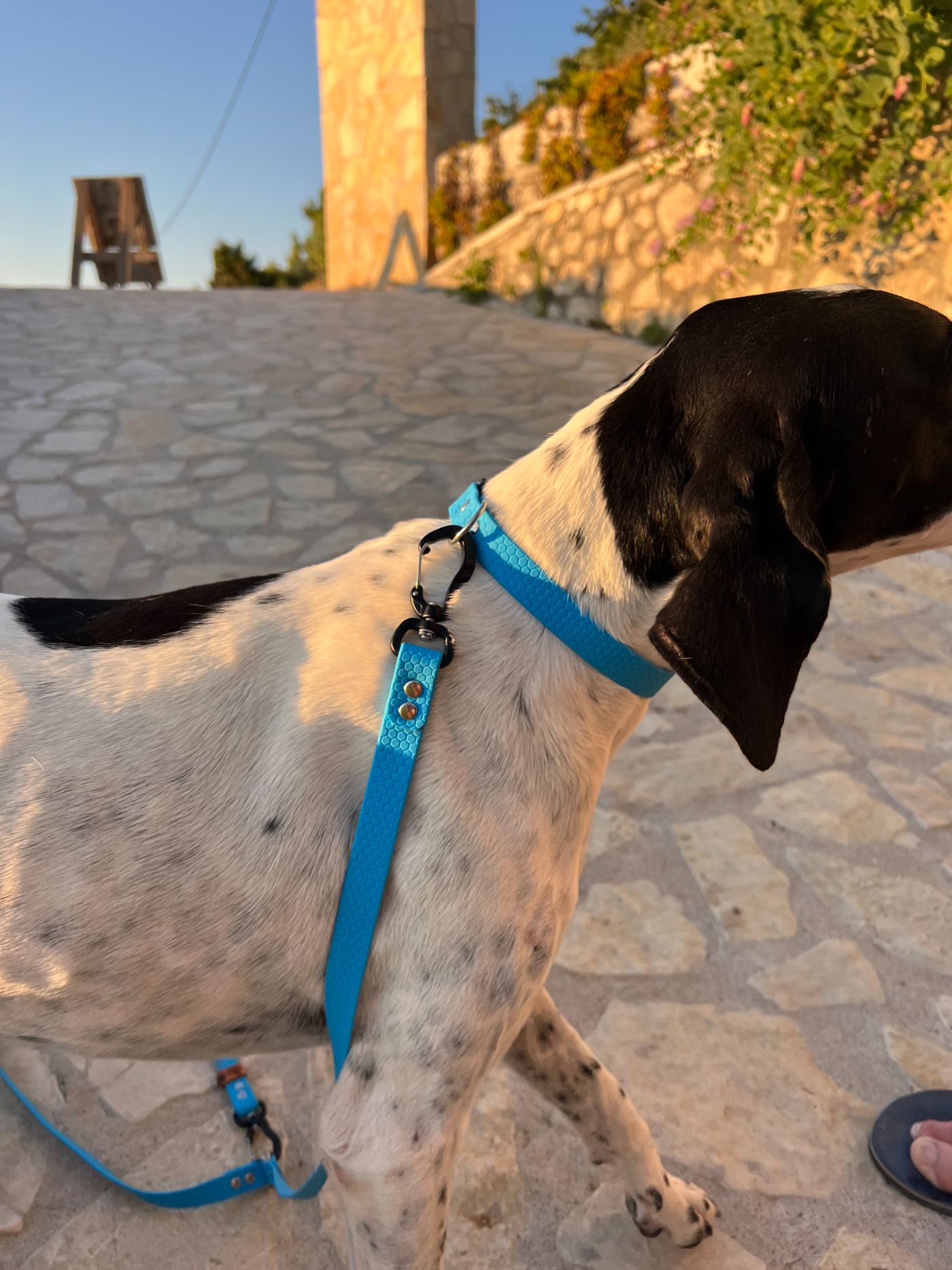
Our HEXA harnesses belong to this long line. They follow the Y-shape that leaves the shoulders free, and they are made from coated webbing that does not absorb water, so they stay light in the rain, at the sea and in the mud. The principle is the same one the Arctic sled harnesses used: spread the load across the chest and let the dog move freely.
Choosing a harness for your own dog? See the HEXA harnesses.